Sexual Reproduction gives genetic diversity to offspring and increases the rate of evolution (produced from two parents). the offspring are identical to the parent.
Asexual Reproduction yields far more offspring and is more convenient (a single parent) where as the offspring are identical to the parent.
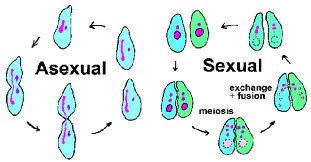
In asexual reproduction, before a cell divides, its nucleus divides. Each chromosone is copied, and each nucleus recieves the same genetic material such as the genes made up of DNA. As each cell divides into two, the resulting "daughter" cells are therefore exact copies of one another.
Asexual reproduction means reproducing without the interaction of two sexes or genders, whereas sexual reproduction involves the fusion of two special cells called gametes, one from a male source and one from a female source
Asexual reproduction in plants starts out with examples such as the spider plant Chlorophytum which produces plantlets on stolons branching from buds in the parent plant. These plants are genetically identical and will grow to look alike, provided that they are raised in the same environment.
Features of the plant's environment would be need to be standardized (for them to look the same). Identical twins are produced by a form of asexual reproduction when the ball of cells making up the embryo breaks into two, and each implants in the uterus and grows independently (after the normal sexual form of reproduction, obviously!
There are advantages and disadvantages to reproducing asexually and sexually and they are:
Advantages: Asexual Reproduction is faster, which is good for producing a lot of offspring. Sexual Reproduction produces more variation, which is necessary for evolution. | Disadvantages: Since there is no genetic variation in Asexual Reproduction, a disease may wipe out all offspring of the original cell. Sexual reproduction is a lot slower, and needs special processes to create and protect the zygote.
|
The female reproductive system is made up of many different organs: the uterus, fallopian tubes, ovaries, vagina, cervix and vulva. To conclude it the hormones: estrogen, progesterone, Gonadotropin Releasing Hormone (GnRH), and Follicle Stimulating Hormone (FSH).
The two main hormones are Estrogen and Progesterone. These two hormones are very closely interrelated. Very few women are deficient in estrogen; most are deficient in progesterone. Some examples of how estrogen and progesterone work together are: estrogen increases body fat - progesterone uses fat for energy, estrogen causes fluid retention - progesterone is a natural diuretic, estrogen increases risks of breast cancer - progesterone helps prevent it.
Estrogen can become dominant if your body has higher levels of estrogen in your body than progesterone. Every female is born with immature eggs in her ovaries, and once they mature, they are released so that it can be fertilized by sperm. This process is known as the Menstrual Cycle.
During the first days of this cycle, the levels of estrogen decrease, signaling the body to increase its production of FSH, which promotes the maturation of the follicles that contain the eggs. Once a dominant egg matures enough, it signals to stop producing so much FSH. A day and a half before ovulation occurs, the estrogen levels get even higher, making the follicle release the egg. Once the ovaries release an egg, it has about 72 hours to be fertilized. If it isn't fertilized, it dries up and the endometrium lining will shed itself, resulting in her period.
If the egg is fertilized, the body begins to produce the 'pregnancy hormone', which makes sure the body produces the right amounts of hormones, and the ideal conditions for implantation.
Implantation happens when the cells nestle into the uterine lining and rupture tiny blood vessels. This forms a connective web of blood vessels and membranes which is what provides nourishment for the developing fetus for the rest of the nine months. After implantation, the embryo enters the Embryonic stage. This lasts 8 weeks and is where most of the development occurs:
Week 3 the brain, heart, blood cells, circulatory system, spinal cord, and digestive system
Week 4 the bones, facial structures, start of limbs, nervous tissue, and continued development of brain and heart (which finally starts to beat).
Week 5 the fetus's eyes, nose, kidneys, lungs, digestive tract, continued development of brain, nervous system, and heart
Week 6 its starts developing the hand, feet, fingers, toes.
Week 7 the fetus's hair follicles, nipples, eyelids and sex organs.
Week 8the facial features, internal organs are well developed, brain can signal muscles to move, and the heart is fully developed.
By the end of the embryonic stage, all essential structures are formed, and we now call the embryo a fetus. Then it enters the fetal stage.
Development is the most dramatic during this stage: The weeks from 9- 12 the fetus reaches 8 cm, the head is half the size of the whole fetus, and it can make a fist. Week 13-15 = fetus reaches 15 cm, and it can swallow and suck. Week 16-20 = fetus reaches 20 cm, finger/toenails, eyebrows & eyelashes appear, and the mother can start to feel movement of the fetus. From weeks 21- 24 the fetus reaches 28.5 cm, a startle reflex develops. Week 25-28 = fetus reaches 38 cm, brain and nervous systems rapidly develop, and fetus gains more control over its movements. During the weeks of 29 to 32 the fetus reaches 38-43 cm, fat deposits become more pronounced, breathing movements begin, fetus's boned are developed but not hardened. During week 33 to 36 the fetus reaches 41-48 cm, fingernails are fully grown, fetus has higher control over its movements. During week 37-40 the fetus reaches 48-51 cm, and is considered full-term (thick hair on head, and all organ systems are functioning).
|
The diet of the mother can affect the development of the fetus. For example, if the mother does not get enough Folic Acid, their baby could develop a neural tube defect (incomplete development of the brain and spinal cord). This type of defect occurs during the first 28 days of pregnancy, sometimes before the woman even knows she's pregnant. Folic acid is crucial in the development of DNA, and plays a large role in cell growth and development, as well as tissue formation. Another example of the mother's diet affecting the baby is with Fetal Alcohol Syndrome. The alcohol easily passes across the placenta to the fetus, therefore easily affecting it. A baby with FAS doesn't grow as well, has decreased muscle tone, poor coordination, thinking, speech, movement, and social skills problems, and sometimes problems with their face. Birth control pills prevent pregnancy mainly by stopping ovulation. If no egg is released, there is nothing to be fertilized by sperm, and the woman cannot get pregnant. Most birth control pills contain synthetic forms of two female hormones: estrogen and progesterone. These synthetic hormones stabilize the natural hormone levels, and prevent estrogen from peaking mid-cycle. |
The video above shows the egg fertilization which somewhat represents the topic! 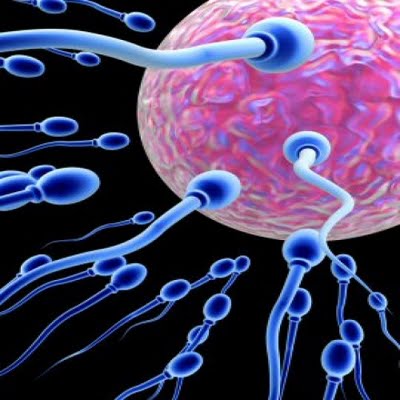
Creatures that live on land and lay eggs use amniotic eggs. These contain an external shell and membranes which create a protecting environment for development without drying out. It has a fluid filled sack for surrounding and cushioning the developing embryo. The yolk sac is a bag like structure that serves as a food supply of nutrients for the embryo. The albumin is the 'white' of the egg, and is covered by the shell which protects the whole egg from drying out, but still allows air to reach the embryo.  | Fertilization There are 2 types of fertalization: external and internal. External fertalization occurs mostly in wet environments, and requires both gametes (reproductive cells that unite from meiosis during reproduction to form a zygote) from the male (sperm) and female (egg) to be released into their surroundings. Fish and amphibians sexually reproduce this way. The advantage to this is it results in a large amounts of offspring being produced, but the disadvantage is that there are many environmental hazards (ie predators) largely reduce the chances of adulthood survival (like in "Finding Nemo" when the barracuda killed all of the eggs but Nemo's). Also many sperm don't actually reach the egg for fertilization. Internal fertalization is what most land animals (invertebrates and vertebrates) use. It needs sperm cells provided with fluid to swim through to the female reproductive trait. This type of fertilization requires close physiological and behavioural synchronization of both partners involving hormonal control. The benefit to this system is that the embryo is more protected. Mammals (except egg-laying mammals) allow the embryo to develop in the mother, increaseing its chance of survival since the mother supplies everythign the embryo needs. The sperm in male land animals are supplied with their own liquid to swim in. This liquid mixture is moved through the ejaculatory ducts toward the urethra. Finally, about a teaspoon of semen is ejaculated through the far end of the urethra at the end of the penis. From the time the sperm leave the man’s body, they have between 12 and 48 hours to find and fertilize an egg cell.
The fertalization of earthworms is completely different. They have the ability to produce both eggs and sperm but they are unable to line up their sexual reproductive areas to self fertilize their our eggs with their own sperm. Soon then he crawls backwards into his tunnel and the slime tube slips forward off of his body. As it does, it passes over the male and female openings, the eggs (from the parent) and the sperm (from the mate) are released from the body. Fertilization takes place outside of the body, but within the protection of the slime tube. Once free in the soil, the slime tube dries, shrinks and forms a protective covering over the eggs. It is now called a cocoon.
|
