Passive and Active Transport
Active Transport is an organism that has specialized tissues to absorb nutriens, they eliminate watse and transport nutriens. These are found in large complex life forms.
Passive Transport is an organism that has a non-specific transport of nutrients and waste.
Diffusion and active transport relate to the transportation of nutrients in a living system by how the nutrients; which are glucose, and oxygen can diffuse spontaneously throughout our bodies where carbohydrates are broken down in our digestive system. Glucose is moved from our intestines into our bloodstream by using active transport and diffusion.
Fresh oxygen in the air is breathed into our lungs where it is going to diffuse across speciallized cells that are called aveoli. The wastes in our body are secreted directly through our skin.
There are some animals that do not have blood, veins, or a heart. Instead, they rely on active transport and diffusion to move the nutrients around in their body. Some of these animals are jelly fish, corals, and planaria worms.
For example a Planarian worm (flat worm)
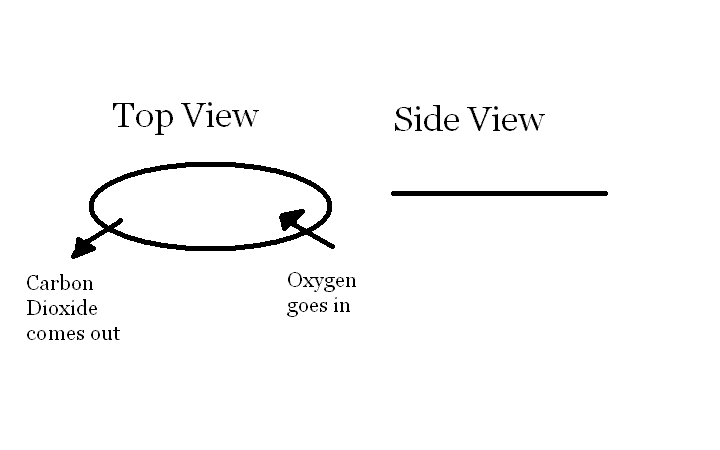
The Circulatory System moves blood to a certain site where it will be oxygenatied and where the wastes can be disposed.
Many invertebrates do no have a circulatory system because their cells are close enough to their environment that oxygen, gases, nutrients and waste products to diffuse in and out of their cells. There are also animals with multiple layers that can't do this because their cells are to protected from the external environment.
The Open Circulatory System are made up of arthropods and mollusks, and there is no "true heart" or capillaries. But instead they had blood vessels that act as pumps to force the blood along. These blood vessels directly join with the open sinuses. Therefore the blood is forced from the vessel to the large sinuses and get it baths the internal organs, the other vessels take the blood from the sinuses and get it back to the pumping vessels. There are some insects that can use this system because they have openings in their body that allow the blood to get air inside. A real life example of this is a "bleeding" halloween costume, that you have a pump that pushes the blood out and up and will eventually get back to the pump. The blood is only partially contained within a system of blood vessels An example would be: 1 or more hearts like organs pump blood through blood vessels into a system of sinuses or some sort of spongy cavities.
 | This figure shows the parts of the body in the Circulatory System and where they belong. 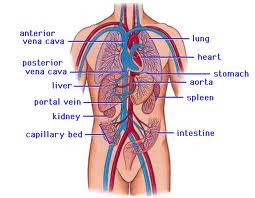 The Closed Circulatory System has blood that is being pumped through a closed system of arteries, veins and capillaries; they surround the organs to make sure that all cells have an equal opportunity for nourishment and removal of the wastes. A heart or a heartlike organ forces the blood through vessels that extend throughout the body, and the blood only stays withing these vessels. There are 4 different types of circulatory systems as we move up the evolutionary ladder. The simplest type is the: 1 Chambered Heart they have 2 main blood vessels and they are dorsal and ventral vessel. An example of this is an earthworm. The blood carries toward either the head or the tail. Blood is moved along the dorsal vessel by waves of contraction which is called peristalsis. In the front of the worm, there are 5 different pairs of vessels that connect the dorsal and ventral vessels. These connecting vessels act as basic hearts, and forces the blood into the ventral vessel.They are not super-efficient since blood could flow backwards, but the earthworm's skin is thin and is always moist so there is an opportunity for exchanges of gases and can make this system possible for the earthworm.
2 Chambered Heart is composed of 1 atrium and 1 ventricle. It has muscular walls and a valve between its chambers. A good example of this is in fish. Blood is pumped from the heart to the gills where it recieves oxygen and gets rid of carbon dioxide, then it moves onto the organs of the body where nutrients, gases and wastes are exchanged. There is no division of circulation between respiratory organs and the rest of the body. Blood travels in a circuit that takes blood from heart, to gills, to organs, and then back to the heart.
3 Chambered Heart is made up of 2 atria and 1 ventricle. This system is in frogs and other amphibians. Blood leaving the ventricle comes to a forked aorta; blood can either go through a circuit leading to other organs. Blood that is returing to the heart from the lungs goes through 1 atrium, while blood returning from the rest of the body passes into the other and both of the atria are emptied into the only ventricle. Therefore this mixes up oxygenated and deoxygenated blood so organs don't get blood saturated in oxygen. It only works with cold blooded creatures like a snake.
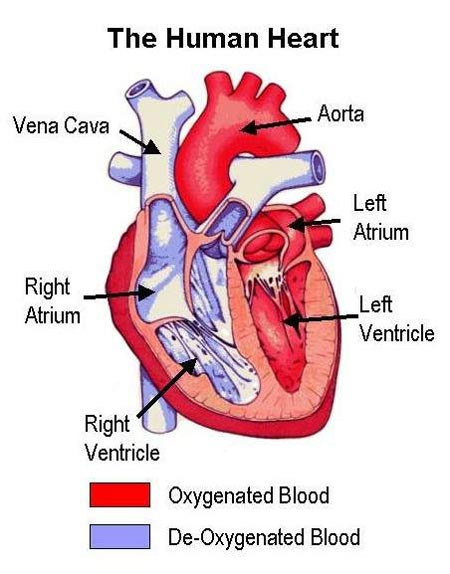
4 Chambered Heart system is used by humans, mammals and birds. It is made up of 2 atria and 2 ventricles. There is one ventricles for deoxygenated blood and another for oxygenated blood. The 2 chambers ensure efficient and rapid movement of highly oxygenated blood to the organs in the body. It is more efficient when blood leaving the heart will have more oxygen than it would otherwise. It is good for enhancing the fast-paced lifestyle of birds and mammals. |
