The human nervous system all starts with the structure of a neuron. Inside the neuron is the some the soma which is the
cell body and it contains the nucleus & all of the cytoplasmic organelles of a typical cell. If the soma is destroyed, the
neuron dies.
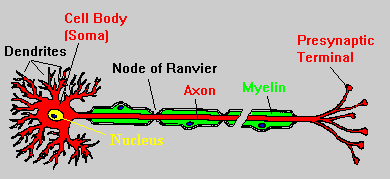
The axon cone is the part of the neuron that’s most sensitive to changes. The first part of the neuron that shows the presence of a nerve impulse called the action potential. The axon is an electrically excitable cytoplasmic strand that conducts the action potential as a multiplying depolarization.
The axonal arborization is the branching of the axon for communicating with other neurons. The nervous system has structural cells called glial cells, which support the neurons structurally and metabolically, it controls their chemical environment.
Axons are usually covered with a type of glial cell called Schwann cells, which give an insulating nerve
sheet to prevent axons to have contact with each other, but it may short circuit of electrical impulses.The
Schwann cells have vertebrate neurons which wrap repeatedly around the axon. Schwann cells have
invertebrate neurons that are wrapped loosely around the axons & make a continuous sheath.
Schwann cells have both vertebrate and invertebrate neurons!
The myelin sheath on vertabric neurons isn’t continuous; it is interrupted at the intervals with gaps called the nodes of ranvier.
The video above shows and states the definitions of each of the bolded and some underlined terms are. It also explains what the neuron structure is like!
Neurons transmit impluses by using the brain. The brain has millions of nerve cells. Cells in the brain send signals from one part of the brain to the other. An example of this in real life is how students in a biology class start passing notes from the front of the class to the back of the classroom. Nerve cells communicate at a junction called a synapse, where signals move from one neuron to another. Synaptic cleft, a small space between 2 cells, is where everything happens. The cell that sends the message if filled with round sacs (vesicles) that contain a neurotransmitter molecule. The neurotransmitters are used along the reward pathway is dopamine. The cell that is receiving the message is coated with dopamine receptors. After dopamine molecules are released into the synaptic cleft, they match to the dopamine receptors on the receiving cells like a lock and key! When dopamine is docked, the receptor sets into a motion with many events which results in the making of a 2nd messenger molecule. Also, when dopamine has finished its job, it is released from the receptor and travels back to the sending cell through other transporters; then it is neither packaged for reuse or broken down. Once the 2nd messenger is made, it starts a nerve impluse which travels down the axon of the neuron. When the impulse reaches the end of the neuron the vesicles with neurotransmitters are stimulated to dump out their contents and after that, it starts over again. Therefore the receiving cell has now become the sending cell. If there is not enough neurotransmitters to attach to receptors, therefore the neuron won't fire an impulse. ** One neuron can synapse with as many as 1,000 other neurons!!!
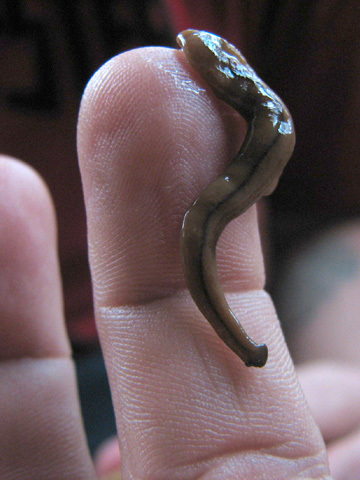
| The difference of nervous systems between a planaria worm, earth worm and a human nervous system is that the planaria worm has a nerve net which is a collection of seperate, but connected neurons. The nerve net is connected by long nerve cords. The nerves are connected to a cerebral ganglia, they are located in the head region. The central nervous system is "ladder-like" because of the nerves that are connected to the nerve cords. The planaria worms have auricles that project from the side of the head, which contain chemoreceptors that are used to find food. The worms have eyespots called ocelli that are very sensitive to light and are connected to the cerebral ganglia.
 The earthworm has a nervous system that is "segmented" just like the rest of the body. Their brain is found above the pharynx and it is connected to the 1st ventrical ganglion. If the brain is cut off or removed the earthworm will move continuously. If the 1st ventral ganglion is removed the earthworm will stop eating and won't dig anything. Each segmented ganglion receives sensory information from a local region of the body and controls muscles in the certain region. Earthworms have touch, light, vibration and chemicals receptors along their entire body. 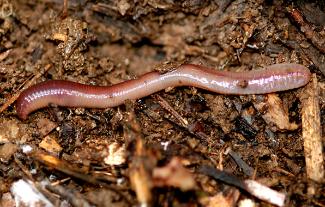 The Human Nervous system is split into 2 different parts the Central Nervous System and the Peripheral Nervous System. |
The Central Nervous System is divided into 2 parts, the brain and the spinal cord. The average adult brain weighs about 3lbs. The brain contains an average 100 billion nerve cells (neurons) and trillions of support cells called the glia. The average female spinal cord is about 43cm long, and the average male spinal cord is about 45cm long. Both female and male spinal cords, approximately weigh about 35-40 grams. And the vertebral column (backbone) is around 70cm long.
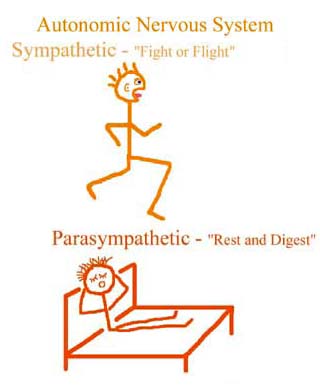 | The Peripheral Nervous System is also divided into 2 parts, the somatic nervous system and the autonomic system. The somatic nervous system has a peripheral nerve fibers that give sensory information to the central nervous system and motor fibers that project it to the skeletal muscle. The cell body of the somatic nervous system is located either in the brain or the spinal cord because it must direct to the skeletal muscle. It has one neuron between the central nervous system and the target organ. Whereas the autonomic system uses two neurons. The autonomic nervous system controls smooth muscle of the internal organs and glands. The system is divided into 3 parts and they are the sympathetic, parasympathetic and enteric nervous systems. The autonomic nervous system regulates homeostasis, as well as the two opposing divisions. Sympathetic is often referred to as the "fight or flight" system! Parasympathetic is often referred to as the "rest and digest" system!
The difference between these two systems is that the Central Nervous System collects neurons that are called nuclei and axons that are called tracts. The Peripheral Nervous System collects neurons that are called ganglia and axons that are collected are called nerves.
|
